
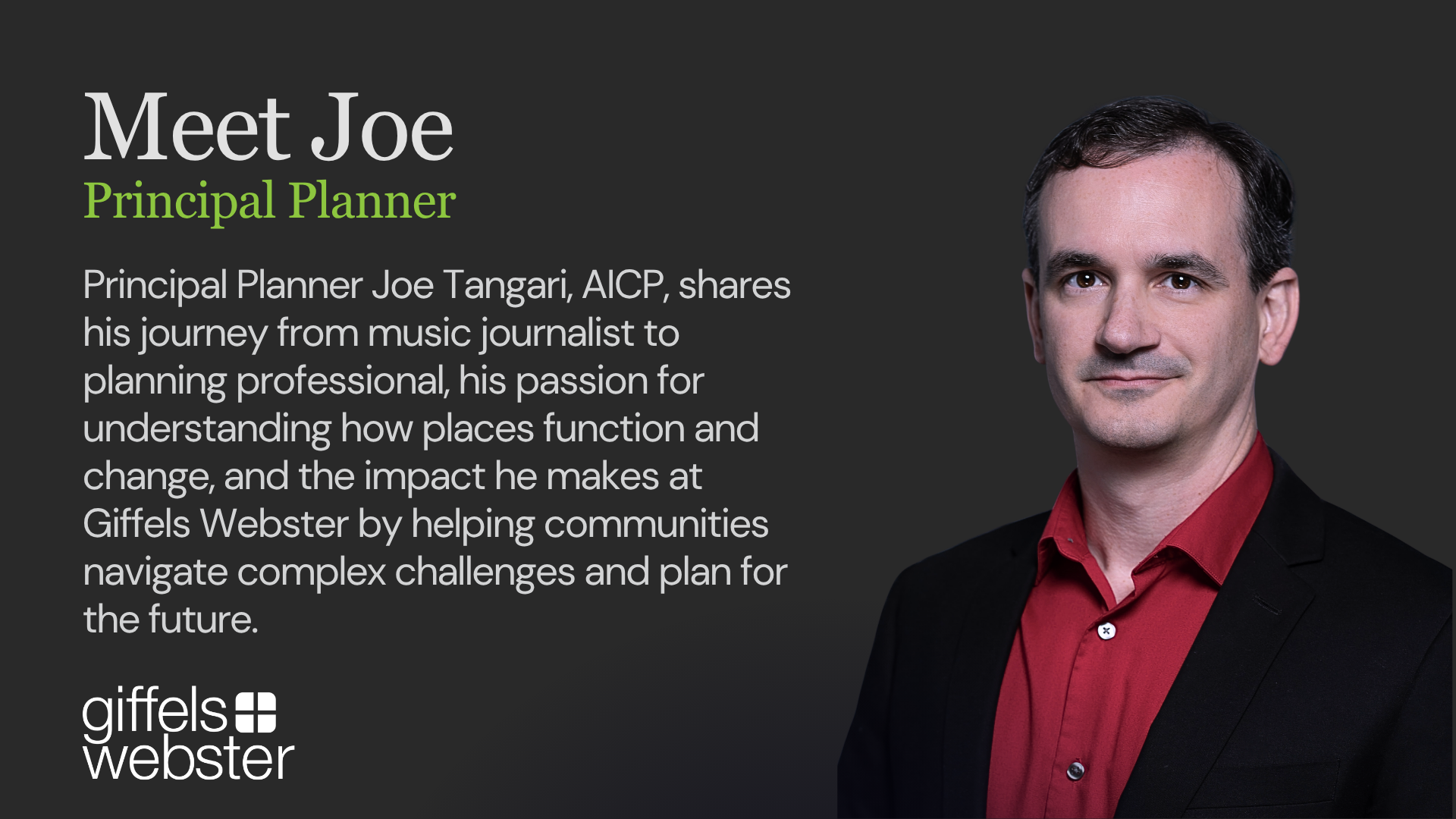
At Giffels Webster, our strength comes from people who bring curiosity, perspective, and a genuine passion for the communities they serve. They think deeply about how places function, how they change over time, and how those changes affect the people who live there. One of those people is Joe Tangari, a Principal Planner who has been part of our team for 12 years.
In this employee spotlight, Joe shares how an early fascination with cities, combined with his experiences living in communities across the country, eventually sparked an interest in planning. From building cities with Micro Machines and playing SimCity to pursuing careers in music journalism, advertising, and other fields before returning to school, his journey reflects curiosity, exploration, and a growing desire to help create better places. Today, he brings that perspective to his planning work, helping communities tackle complex challenges and turn ideas into practical solutions.
Read on to learn more about Joe’s path, what keeps him excited about planning, and his advice for those considering a career in the profession.
1. Tell us your full name, role, and how long you’ve been with the company.
Joe Tangari, Principal Planner, 12 years, though the first two of those were with Clearzoning before we joined Giffels Webster.
2. What sparked your interest in planning as a career?
My interest in planning is deep-rooted. As a kid, I built cities for Micro Machines, played a lot of SimCity, and rode my bike all over my hometown, which was very rural. I grew up in the slowly suburbanizing countryside of Connecticut, so I saw how places can change over time. I also moved directly from there to Boston for college, and that was hugely eye-opening. Suddenly, I was walking and taking transit everywhere after growing up in a place where a car was the only way to run even the smallest errand. It planted the idea that cities should function in a way that lets people live their lives freely.
After Boston, I lived in an old suburb of Chicago, and then a newer exurb, while working downtown and taking the commuter train every day. Living in that exurb taught me that there are ways communities just shouldn’t be built. I hated it. We moved to Fayetteville, Arkansas, for five years so my wife could get a graduate degree, and we lived right in the midst of all the good and bad that modern development has to offer, in microcosm. I got involved in a local debate about where the high school ought to be located, and that was the first time I ever met an actual professional urban planner. Moving to Detroit and seeing firsthand all the effort going into reviving a city many had written off as dying is what pulled me into the field and convinced me to go back to school.
3. Was this always your dream job, or did your career path take a few turns?
No! I didn’t even know it was a job until I was an adult. I spent years doing day jobs in insurance, advertising, and animal rescue while working as a music journalist, and it was a big shift for me to go back to school, get a professional graduate degree, and make my day job my only job. Honestly, I think doing grad school in my 30s was for the best. I was able to do it with a real sense of purpose.
4. What do you love most about working in planning today?
I think there’s growing awareness among the broader public about some of the things planners have been talking about for almost twenty years now. We’ve developed more tools, knowledge, and understanding for addressing many of the challenges our communities face. Now, it’s about bringing those ideas together and turning them into collective action.
5. What’s one project or moment you’re especially proud of in your career so far?
I recently completed a guide to amending a sign ordinance for the Wisconsin Economic Development Corporation and Wisconsin Main Street that took a unique, practical approach and will help people make real progress. We got to think about the problems we’re so often faced with in a more distanced way, and it gave me the chance to develop a whole new framework for figuring out how an ordinance should be considered during an amendment process.
6. What would you tell someone about considering a career in planning?
Anyone considering a career in planning should think hard about what animates their interest. If you’re an activist at heart, search for a role that builds on that activist spirit. If you’re into the technical or legal side of things, there are paths for that, too. Planning is a small universe unto itself, and it has room for all kinds of people. It all starts with caring about the places we live in and the people who live there.
7. What do you enjoy outside of work?
I’ve been a musician since I was a teenager and that is still part of my life, creating on my own and playing with friends in a cover band called the Paisley Fogg. My family has cats and supports local animal rescues, too. I’m a big reader, and I find myself giving little bits of time to all sorts of things, from bicycling and playing soccer badly to history, photography, and other visual arts.
At Giffels Webster, we’re proud to support team members like Joe, who bring curiosity, perspective, and genuine commitment to the communities they serve. His journey shows how varied experiences, a willingness to keep learning, and a passion for better places can lead to a meaningful, impactful career in planning.
Stay tuned for more spotlights as we continue to celebrate the talented people who shape our firm and help communities across Michigan plan for what comes next.
Want to learn more about careers at Giffels Webster? Visit https://giffelswebster.com/careers/.


